

I’ve lived with depression long enough to know that fixing myself is a myth. If anything, the pressure to “be fixed” often makes things worse. So when a mental health book tells me upfront that it’s not here to cure me but to walk beside me, I feel good. Indeed, ACT Therapy Companion for Trauma, Anxiety, and Depression in Adults feels like a companion instead of the usual toxic positivity disguised as self-help.
From the very first page, Greer Riley, an artist, scientist, and spiritualist, speaks in a gentle, grounded manner. There’s no jargon, patronizing advice, or promises of instant change. For someone who often approaches self-help books with skepticism, this was a breath of fresh air.
A Workbook That Understands Low-Capacity Days
The best part about this book is that the exercises are doable even on days when your brain feels like wet cement. ACT (Acceptance and Commitment Therapy) can sound intimidating if you’ve only encountered it in psychological texts, but Riley makes it feel human. She explains concepts like psychological flexibility, acceptance, cognitive defusion, and values clarification simply, with metaphors that actually land.
For example, the Cognitive Defusion Practice asks you to take a recurring painful thought, label it, visualize it, and watch it drift by like a cloud or a leaf. It’s not about stopping the thought, it’s about loosening its grip on you. On a day when my mind tells me I’m failing at everything, this exercise is like telling my brain, “I hear you, but I’m not handing you the steering wheel.”
The same goes for her section on values clarification. Instead of telling you to be positive, she asks you to reflect on what actually matters to you. This isn’t the kind of workbook that asks for your five-year plan. It asks what kind of person you want to be today, even in small, imperfect ways. In a world that demands productivity even from those barely holding on, this is refreshingly humane.
Healing Without Erasing Your Humanity
One of the strongest threads running through the book is the reminder that avoidance of emotions, responsibilities, conflict, or pain isn’t a personal failing. It’s a learned behavior, and like any learned behavior, it can be gently unlearned.
This part hit home because so many of us living with depression or trauma carry shame around the ways we cope. Riley dismantles that shame without dismissing the consequences. She offers mindfulness exercises, journaling prompts, and step-by-step reflections that help you understand why you avoid things and how to approach them with curiosity.
The tone throughout is to be kinder to yourself while you try. Even the trauma-focused sections maintain this softness. There are grounding techniques, visualization exercises, and self-compassion practices designed to help you reconnect with your body and your sense of safety. Nothing is rushed; the book respects the slow and courageous pace at which trauma survivors move.
A Method That Doesn’t Promise Perfection
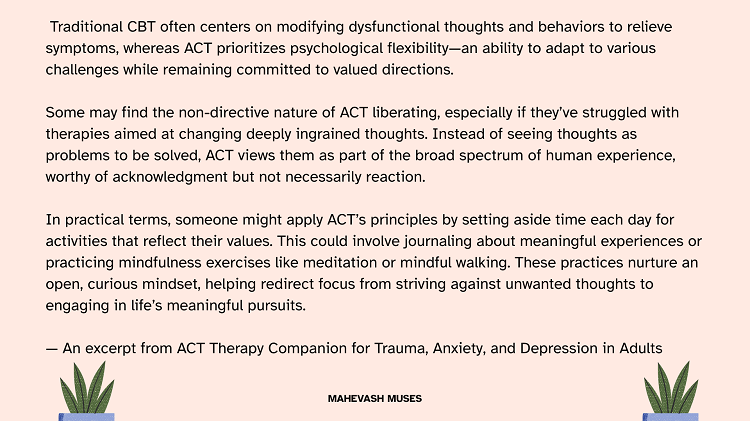
ACT’s core message is that you don’t have to control your thoughts or feelings to build a better life.
Riley reinforces this through mindfulness, present-moment awareness, and committed action. She writes about learning to show up for your life even when your thoughts are messy and your emotions are loud. She writes about aligning small actions with your values, not as a moral obligation but as a way to feel more like yourself.
For me, the chapter on being present was a turning point. It acknowledges how much time we spend replaying the past or catastrophizing the future — not because we want to, but because anxiety and depression compel us to do so. The techniques she offers, like sensory awareness and body scan meditations, are presented as anchors, not cures.
Who This Book Is For
This workbook is for anyone who:
- wants a gentle introduction to ACT
- feels overwhelmed by traditional CBT-style “fix your thoughts” approaches
- appreciates small, manageable exercises
- wants to live more intentionally but doesn’t know where to start
- is tired of self-help books that talk down to them
Conclusion
Greer Riley’s ACT Therapy Companion for Trauma, Anxiety, and Depression in Adults is not here to transform you into a better version of yourself. It’s here to help you meet yourself—the real, hurting, human you—with more compassion and clarity.
In a mental health landscape filled with quick fixes and unrealistic promises, this book permits you to be imperfect, present, and still worthy of healing. If you prefer narrative-driven mental health books, this workbook might feel too structured. That said, if you’re looking for a wise companion on the long, uneven road of living with your mind instead of fighting it, this workbook is exactly that. For those of us living with trauma, anxiety, or depression, Riley offers tools to help us live with more resilience and a clearer sense of self.
Purchase Your Copy on Amazon
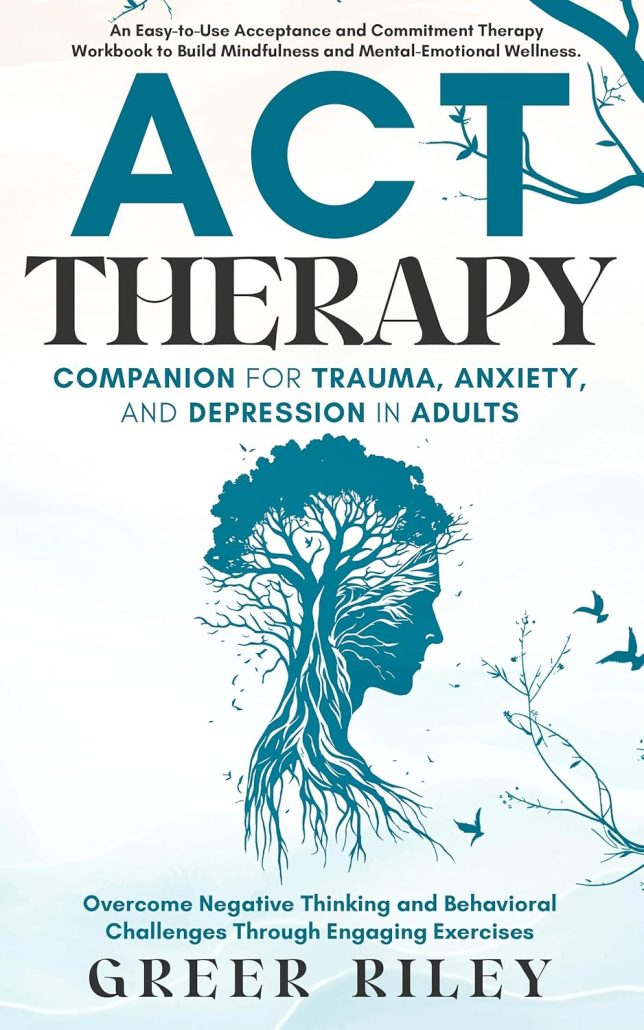
Amazon US: https://www.amazon.com/Therapy-Companion-Trauma-Anxiety-Depression/dp/B0DWFQ85DF
Amazon Canada: https://www.amazon.ca/Therapy-Companion-Trauma-Anxiety-Depression/dp/B0DWFQ85DF
And Amazon India: https://www.amazon.in/Therapy-Companion-Trauma-Anxiety-Depression-ebook/dp/B0DWFRFHJV/
