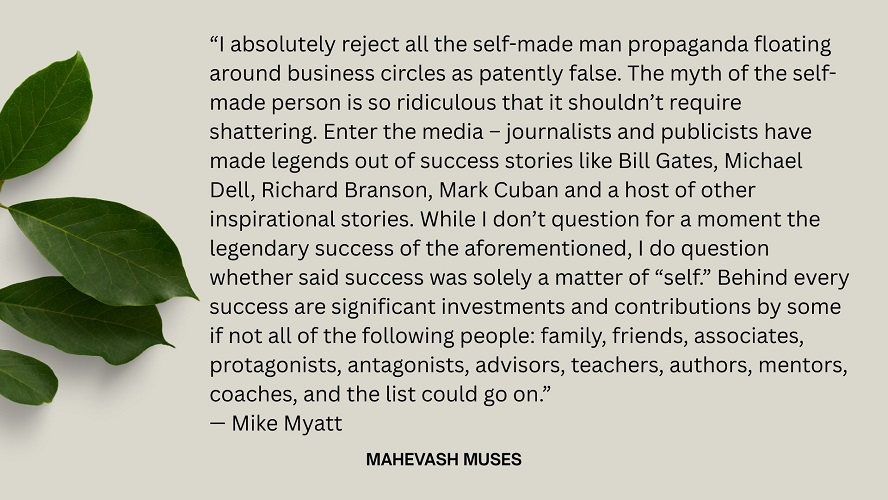
We admire people who claim to be self-made, but the idea that a single person succeeds without support has never been true. Success has always been shaped by community, privilege, timing, opportunity, and care. When we cling to the self-made man myth, we lose sight of the fact that every person who thrives has benefited from external support.
Why the Self-Made Myth Is So Appealing
We are surrounded by stories about people who built their lives from nothing through hard work, discipline, and talent. These narratives give us hope because they suggest that success is available to anyone who tries hard enough. They present independence as the highest virtue and imply that depending on others is a sign of weakness. Many of us internalize these ideas without questioning them because they are everywhere, especially in media, pop culture, and entrepreneurial spaces.
For example, people love pointing to billionaires like Elon Musk or Jeff Bezos as examples of “self-made” folks. However, both these men had significant advantages that shaped their journey. Musk came from a financially comfortable family that funded his education overseas, and Bezos received nearly $250,000 from his parents to help Amazon survive its early years. And let’s not forget the constant support of his ex-wife, MacKenzie Scott, who helped build Amazon from the ground up.
Unfortunately, these facts rarely appear in motivational speeches, because the myth of the completely independent man feels more exciting than the truth that most people succeed due to external support.
No One Truly Rises Alone
When success is examined closely, it becomes clear that every person who thrives has benefited from some sort of external support. Some advantages are visible, such as access to education, financial resources, safety, or social privileges. Others are subtle, like having someone who believed in us, someone who recommended us for an opportunity, someone who cared for us during stressful times, or someone who helped build our confidence when it was fragile. Personal effort matters, but it is never the whole story because our environment shapes what effort can realistically achieve.
A clear example of this is Oprah Winfrey, who credits her teachers for changing the course of her life. Without educators who supported her and family members who pushed her to pursue education, she may never have become the media powerhouse we know today. Even someone like Bill Gates has repeatedly acknowledged that access to computers at a young age and the support of his parents were foundational to his success.
The Harmful Influence of Hyper-Individualism
When we cling to the myth of the “self-made man,” what we’re doing is worshipping hyper-individualism. This is the lie that your achievements belong only to you; that the world owes you nothing, and you owe it nothing.
Hyper-individualism encourages the belief that success belongs only to the person who achieves it. It downplays the role of community and convinces people that asking for help is embarrassing, even a sign of weakness. It also pushes the idea that receiving support makes achievements less valuable. This mindset creates loneliness, encourages unhealthy competition rather than collaboration, and sometimes leads people to hide the support they receive because they want to maintain the image of independence.
It also places unfair pressure on people who struggle, telling them that a lack of professional achievements is their personal failure rather than a reflection of the many challenges they face, often all by themselves.
This influence is visible in hustle culture. Many young entrepreneurs feel pressured to act like they are doing everything alone, even when they have investors, employees, and family support. YouTubers and influencers often speak publicly about how they built their brand from scratch, while privately relying on teams, editors, management companies, professional and personal networks, and emotional support from their partners. The performance of self-sufficiency matters more than the reality, which shows how powerful the self-made myth has become.
Acknowledging Support Does Not Diminish Your Shine

When we look at our own lives honestly, it becomes easier to see how interconnected we are. Reflect on your life, and you will remember how someone shaped your mindset when you were young or helped you during a difficult phase. Maybe a teacher or trusted adult guided you academically, professionally, or emotionally. Or maybe someone encouraged you when you felt like giving up. Does that mean that you owe all of your wins to them? No. But does it mean you didn’t get any help along the way?
Others’ contributions do not erase our hard work. They illuminate the full picture of how our growth took place. Honoring the people and circumstances that helped us does not reduce our achievements. It deepens our gratitude and helps us understand success realistically and humanely. When you acknowledge others’ contributions, you glow brighter and earn real respect.
Michelle Obama often speaks about the mentors, community members, and teachers who invested in her long before she ever stepped into the public eye. Her accomplishments are extraordinary, and they exist alongside the support systems that made her growth possible. Each time she credits others, she comes across as far more authentic and grounded than those who claim to be 100% self-made.
A Better Way to Think About Success

A balanced view of success makes space for both personal effort and external support. It acknowledges that grit is important, yet it does not ignore privilege, timing, community, and sheer luck. This perspective allows us to celebrate our achievements without isolating ourselves from others. It makes us more likely to uplift people who are still building their lives. It also reminds us that help is not something to hide; it is something that every human needs at different points in life.
In fact, some of the most socially impactful people openly credit the support they received. Malala Yousafzai regularly honors her father for believing in her and encouraging her education, which allowed her activism to flourish. Actor Keanu Reeves often acknowledges the colleagues and friends who helped him through grief and career struggles. Their willingness to share credit does not reduce the weight of their achievements. Instead, it makes them more relatable and more grounded.
When we release the belief that success must be achieved alone, we create room for collaboration, connection, and kindness. We become more grounded, humble, understanding, and appreciative of the people around us. So celebrate your wins. Own your grit and perseverance. But don’t pretend you carved it all from thin air. You are part of multiple permutations and combinations like family, community, luck, and timing, and all of these came together to help you succeed. When you honor this fact, you will walk with pride and stay humble.
Join the Conversation and the Community
If this post resonated with you, I would love to know your thoughts. Who helped you become the person you are today, and how did their support make a difference?
There is no such thing as a person who succeeds entirely on their own. Anyone who claims to be self-made is leaving out a long list of people and circumstances that helped them along the way.
If you appreciate writing that explores identity, culture, mental health, and the human side of modern life, consider subscribing to the Mahevash Muses newsletter.
Never Miss a Story from Mahevash Muses.