
Suicide in young people is a serious public health problem worldwide. According to the World Health Organization, suicide was the fourth leading cause of death for persons between the ages of 15 and 29 in 2019.
India’s rates of youth suicide are some of the highest in the world. Suicide rates in 15-29-year-old Indian men are estimated to be twice that of the global average (25.5 vs 13.1 per 100,000), and rates in young Indian women are nearly 6 times as high (24.9 vs 4.1 per 100,000).
Suicide is the leading cause of death for both men and women in this age group. According to official estimates, over 60,000 young people died by suicide; these figures are likely to be under-estimated by at least 25% if one considers data from nationally representative surveys.
Leading Causes of Suicide in India
In India, the top 10 causes or correlates of suicide in 2009 were family problems (23.7%), illness (21%) [including insanity/mental illness (6.7%)], unemployment (1.9%), love affairs (2.9%), drug abuse/addiction (2.3%), failure in examination (1.6%), bankruptcy or sudden change in economic status (2.5%), poverty (2.3%), and dowry dispute (2.3%).
The high rates of suicide among persons with mental illness and drug abuse/addiction, though not a measure of intent, are of much concern. Many of the remaining causes [namely, suspected/illicit relation, cancellation/nonsettlement of marriage, not having children (barrenness/impotence), death of a dear one, dowry dispute, divorce, ideological causes/hero worship, illegitimate pregnancy, physical abuse (rape, incest, etc.), poverty, professional/career problem] reflect the unique social structure of our society and the social pressures that individuals face.
Attempted suicide is of particular interest as it is one of the predictors of future suicide. This fact is reiterated in studies that show about 18% of suicide victims had a previous suicide attempt.
In an analysis of suicide attempters which distinguished between those who had intended to die but accidentally survived (failed suicide group) and those who had not intended to die (deliberate self-harm group), Sarkar et al. 2006 found that, in the former, the attempts were planned, intentionality and lethality were high, and most attempted to conceal the act.
Understanding the Events That Can Lead to Suicide

The relationship of suicide to negative life events, stress, object loss, and negative interaction needs to be understood in the framework of a model of vulnerability, support, coping, and problem-solving. Rich and Bonner found in a stress-vulnerability model that negative life events and stress accounted for 30% of the variance in suicidal ideation. Indian society, being sociocentric, places importance on interpersonal relationships. It is therefore unsurprising that marital conflict is the commonest cause of suicide among women, while interpersonal conflict is the commonest cause among men.
Other suicide triggers include physical illness, bankruptcy, illicit relationships, and drug intoxication. An interesting finding, rarely seen in the West, is the high rate of suicide associated with sexual abuse and illegitimate pregnancy. This may be a reflection of cultural taboos related to sexuality in India.
Studies that measured stressful life events found that approximately 90% of suicide attempters reported negative life events, and about 35% experienced stressful life events in the previous 6 months.
However, in the absence of a control group, it is hard to interpret the significance of life events. After all, everybody experiences stressful or negative life events.
Suicide in Urban India
The suicide rate is generally reported to be higher in urban areas because of a variety of stressors related to living and working in cities, including overcrowding and social isolation.
In India, during the year 2000, though the suicide rate for the country was 10.8, the rate in urban areas was slightly lower at 9.94.
There has since been an increase in urban suicide rates to 11.4% in 2005, around 13% in 2006 and 2007, and 12.1% to 12.5% in 2008 and 2009. Studies in recent years are consistent in this regard: suicide and attempted suicide were more common in persons living in urban areas.
5 Action Steps to Prevent Suicide
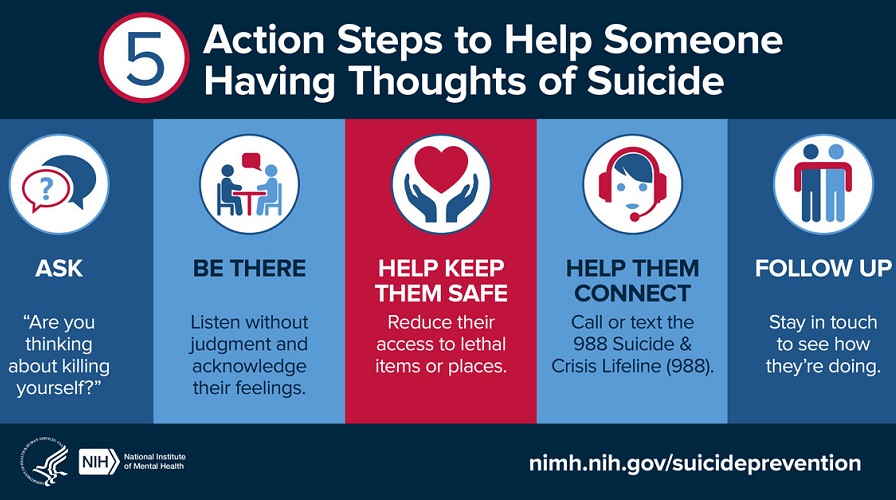
Here are 5 steps you can take to help someone who is having thoughts of suicide:
1. ASK: “Are you thinking about suicide?” It’s not an easy question to ask, but it can help start a conversation. Studies show that asking people if they are suicidal does not increase suicidal behavior or thoughts.
2. BE THERE: Listening without judgment is key to learning what the person is thinking and feeling. Research suggests acknowledging and talking about suicide may reduce suicidal thoughts.
3. HELP KEEP THEM SAFE: Reducing access to highly lethal items or places can help prevent suicide. Asking the person if they have a plan and making lethal means less available or less deadly can help the person stay safe when suicidal thoughts arise.
4. HELP THEM CONNECT: Connecting the person with the Tele-Manas helpline (call 1800-891-4416) and other community resources can give them a safety net when they need it. You can also help them reach out to a trusted family member, friend, spiritual advisor, or mental health professional.
5. FOLLOW UP: Staying in touch with the person after they have experienced a crisis or been discharged from care can make a difference. Studies show that supportive, ongoing contact can play an important role in suicide prevention.
Nikita Bhati (M.Phil., PhD) is a senior clinical psychologist at Samarpan, a premium mental health organization in Mumbai, India.
Never Miss a Story from Mahevash Muses.